


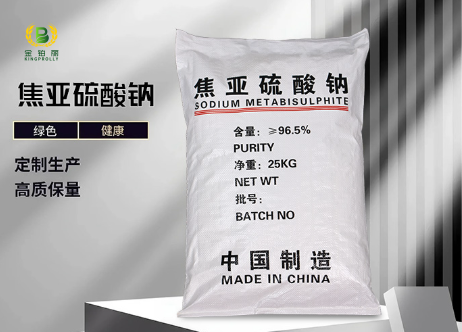
Description
-
Chemical Properties
-
Unstable, Easily Decomposes: Sodium metabisulfite decomposes slowly in moist air or when in contact with water, releasing sulfur dioxide gas. Heat accelerates this process.
-
Strong Reducing Agent: This is its most important chemical property, making it useful as an antioxidant, bleaching agent, and preservative. It reacts with oxidants like oxygen and peroxides, protecting target substances from oxidation.
-
Reaction with Acids: Contact with acids (even weak acids like acetic acid) causes rapid decomposition, releasing large amounts of SO₂ gas.
-
Sulfite Salt: In water, it quickly dissociates into sodium bisulfite. Therefore, its properties in aqueous solution are very similar to sodium bisulfite.
Na2S2O5+H2O→2NaHSO3
Main Applications
Due to its reducing properties and ability to release SO₂, sodium metabisulfite has wide-ranging uses:
-
Food Industry (as a Food Additive):
-
Preservative: Inhibits growth of bacteria, molds, and yeast, extending shelf life. Commonly used in fruit juices, jams, dried fruits/vegetables, wine, etc.
-
Antioxidant: Prevents enzymatic and non-enzymatic browning in fruits and vegetables (e.g., potatoes, apples), maintaining color. Used in canned/frozen fruits and vegetables.
-
Bleaching Agent: Used for bleaching sugar, starch, vermicelli (glass noodles), candied fruits, etc.
-
Dough Conditioner: In baking, improves dough texture and extensibility.
Note: On food labels, it is often listed as E223.
-
-
Pharmaceutical Industry:
-
Serves as an antioxidant in formulations to protect oxidation-prone active ingredients.
-
Acts as a reducing agent in chemical synthesis.
-
-
Photography Industry:
-
A component of fixing solutions, helping to remove unexposed silver halide.
-
-
Water Treatment:
-
Used as a dechlorinating agent to remove residual chlorine from tap or industrial process water.
-
Used in wastewater treatment for chromium-containing waste, reducing highly toxic hexavalent chromium (Cr⁶⁺) to less toxic trivalent chromium (Cr³⁺).
-
-
Chemical and Textile Industries:
-
Used as a reducing agent in various chemical syntheses.
-
Used as a bleaching and dechlorinating agent in textile printing and dyeing.
-
-
Winemaking (Viticulture):
-
This is one of its most important uses. Used for:
-
Antimicrobial & Antioxidant: Inhibits wild microbes, prevents wine oxidation/spoilage, and preserves fresh fruity aromas.
-
Halting Fermentation: Kills yeast at a specific stage to control sweetness.
-
Clarification: Aids in clarifying the wine.
-
-
4. Safety and Health Considerations
-
Irritant: The powder can irritate the eyes, respiratory tract, and skin. Personal protective equipment (safety glasses, mask, gloves) should be worn when handling.
-
Allergic Reactions: Individuals sensitive to sulfites (particularly asthmatics) may experience severe reactions after ingestion, such as breathing difficulties, asthma attacks, or rashes. Regulations in many countries require foods containing sulfites above a certain threshold to be labeled.
-
Usage Limits: Strict limits exist for residual sulfur dioxide levels in food and wine; usage must comply with regulations.
-
Storage: Must be stored tightly sealed in a cool, dry, well-ventilated place, away from moisture, heat sources, and acids.
5. Differentiation from Similar Substances
-
Sodium Sulfite (Na₂SO₃): Has weaker reducing power than sodium metabisulfite, and its aqueous solution is more alkaline.
-
Sodium Bisulfite (NaHSO₃): As mentioned, sodium metabisulfite in water forms sodium bisulfite. Therefore, their functions in solution are essentially the same. However, in solid form, sodium metabisulfite has a higher SO₂ content, is more stable, and is more convenient for storage and transport.
Sodium metabisulfite is a versatile inorganic salt whose core value lies in its strong reducing power and ability to release sulfur dioxide. This makes it an indispensable antioxidant, preservative, and bleaching agent in industries like food, winemaking, chemicals, and water treatment. However, its safety risks (especially for sensitive individuals) and the necessity for strict adherence to usage regulations are equally important characteristics.
Reviews
There are no reviews yet.